

A reward effect can fill the screen while the result it celebrates disappears behind it. For a creative producer reviewing a merge ad, that creates a precise question: can someone see what the move changed?
Imagine a simple scene in which two small huts slide together and become one larger house. A gold burst spreads across their tile as the new building appears. When the particles clear, the house is there. The celebration has a beginning, a peak and an ending, but the transformation itself has been covered.
That imagined scene gives us a specific production decision to discuss: when should the new house become visible in relation to the reward?
Consider another version with the camera, merge action and final house unchanged. The roof rises into view and the new outline becomes visible before the burst reaches its peak. Gold can still sweep across the frame. The proposed difference is the order in which the scene reveals the consequence and celebrates it.
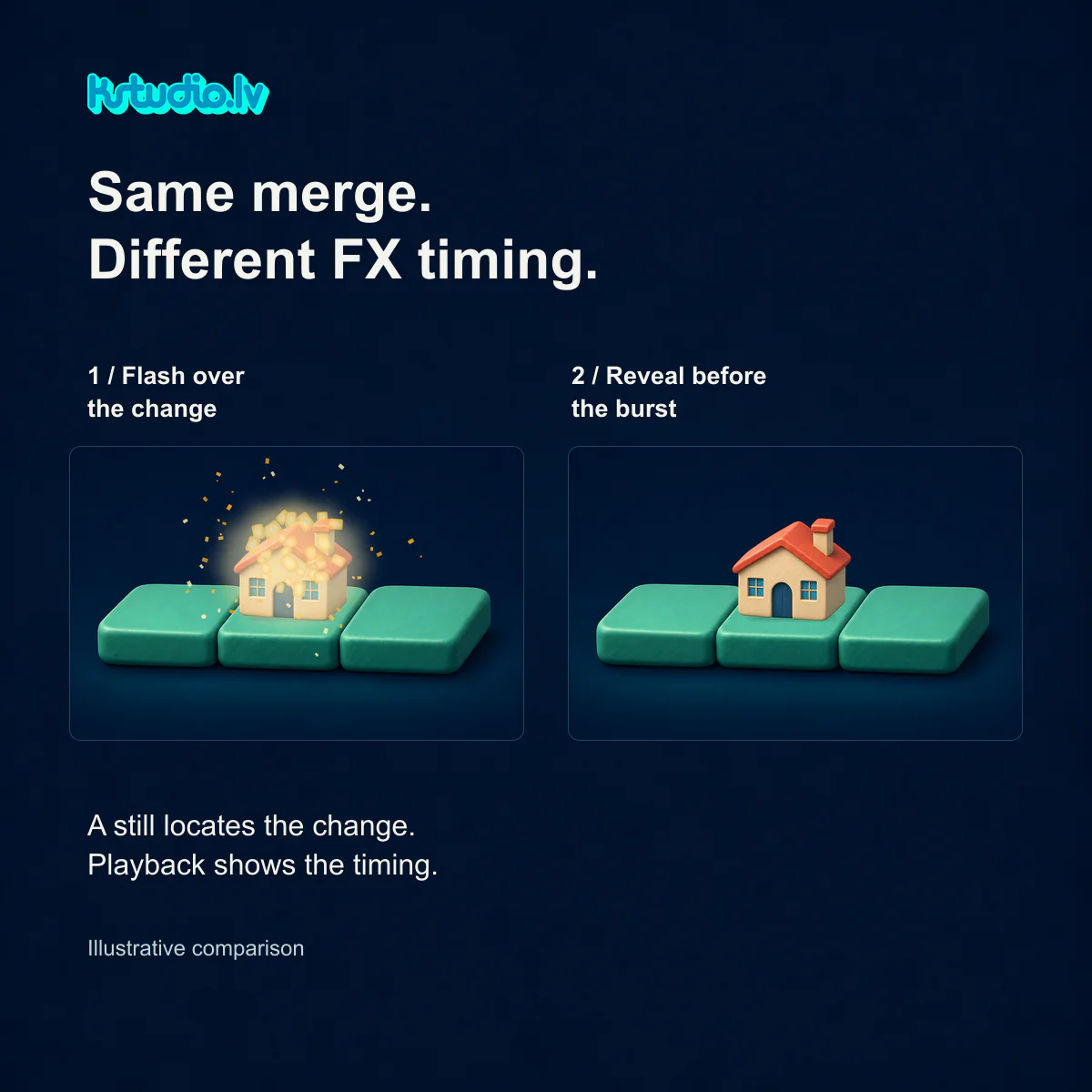
That distinction matters in a review because "less FX" leaves several possible revisions open. An animator might reduce the particle count, lower the brightness or shorten the whole sequence. None of those instructions specifies which piece of information the buyer wants to preserve. If the concern is the new building, the note can name it: "Keep the gold burst. Let the new house read before the effect covers the tile."
There are other possible treatments. The burst could expand behind the house, or leave the roof visible as particles cross the foreground. Those choices preserve a different relationship between the object and its celebration. Which treatment suits the scene depends on its style, pacing and the importance of seeing the transformation. There is no universal instruction to make every reward smaller or quieter.
A deliberate moment of concealment can also belong to the idea. A reveal that hides a mystery prize has a different job from a merge that needs to explain an immediate consequence. The review should follow the intended experience. A large effect is not, on its own, evidence of a readability problem.
The paused image is a useful starting point because it tells you what the new object looks like. It cannot tell you whether there is time to recognise that object during playback. That second question needs the sequence running at its intended speed.
Playable Checker is a separate build resource for static HTML/ZIP/source checks; no execution. https://kstudio.lv/products/playable-checker
For your next review, pause where the merge resolves and locate the new house. Then replay the sequence at normal speed: can you still identify the new house and its position while the reward plays? If you can identify the result only while paused, your note can name that precise problem. The revised sequence can then be reviewed against the same question, with the celebration's style still open for discussion.
Comments (0)
Awaiting moderation. Only you can see this.