
Can the objects carry the story?
When a creative lead is choosing a game video treatment, a character is one possible carrier of the story. Before committing to that treatment, try removing the hero from a rough concept. Can you still identify the goal, the action and the result? The answer gives you a concrete basis for deciding what the character needs to do.
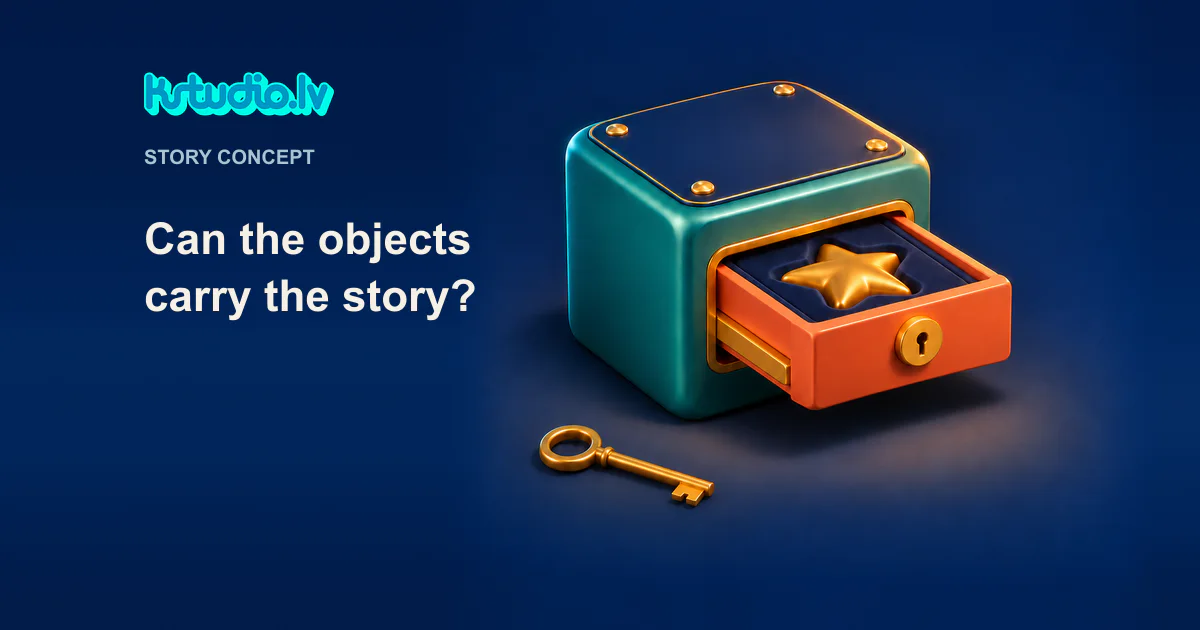
In this proposed scene, a locked chest, a matching key and one gold star inside give us a concrete way to explore the question.

The sequence starts with the chest closed and locked. The key is visible beside the lock, suggesting how the obstacle might be resolved. Next, the key turns and the lock releases. Finally, the compartment opens far enough for the gold star to be clearly visible. Each change needs to follow from the action before it.
In this version, the goal is to open the chest and reach what is inside. The key turn is the action. Access to the star is the result. A closed chest cover can introduce the question, but it cannot show the complete sequence on its own. The opening and reveal still have to be designed.
We would review the rough frames using three practical criteria. First, key visibility: can the viewer identify the key and the lock it belongs to without searching around the frame? Second, causality: does the turn visibly release the lock, or does the chest appear to open independently? Third, payoff: does the final composition reveal the star clearly, or do the opening mechanism and effects hide it?
Keep one opening mechanism consistent across the sequence. The change from locked to open should be easy to follow in the rough storyboard. If a new mechanism appears halfway through, the reader has another rule to work out just as the reward arrives.
There are also good reasons to keep a hero. If the moment depends on delight, hesitation or disappointment, a character's reaction may be the point. Personality and identity can matter just as much as the physical outcome. Removing the character could preserve the puzzle while removing the reason the audience should care about it.
An object only treatment is worth exploring when the rule and reward relationship carries the action. The choice comes back to the job of the hero: what does a person or character communicate that these objects cannot? Static drawings help us discuss that choice. Timing and readability in motion still need an animatic or render and a separate review.
Use the same check on one rough concept of your own. Remove the character, then label the goal, action and result. Write down what becomes unclear or loses its meaning. Use that missing information to decide whether the hero belongs in the next pass, and what job it should have.
If you need help developing an object storyboard or render treatment, KSTUDIO can discuss your brief:
Video Ad Check: export metadata and placement preview, not narrative quality.
Comments (0)
Awaiting moderation. Only you can see this.