
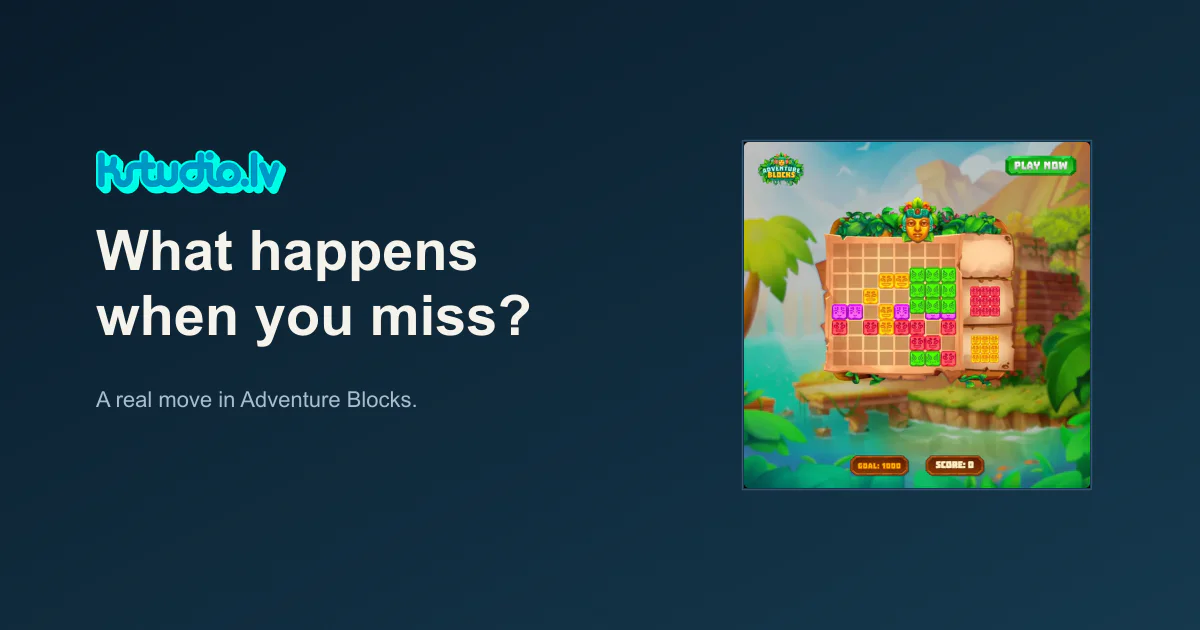
A clean playthrough shows what happens when a player gets the moves right. If you're the creative lead accepting a playable, ask to see a mistaken placement too. The useful question is what state it leaves behind, and whether play can continue.
Watch the rejected move
In our Adventure Blocks studio demo, we dragged a piece onto cells that were already occupied. It returned to the tray. The board and score remained unchanged.
Later in the same demo session, a valid placement was accepted and a new piece appeared in the tray. The footage is edited for length; it is not an uninterrupted recording of every attempt.
Together, those moments show a specific recovery: the rejected move did not prevent a later accepted placement.
Make the acceptance check concrete
For a build review, compare three states: the board before the mistake, the response after it, and the next available action. Did the rejected input leave the board as intended? Is the piece still available? Can the player continue without restarting?
Keep the relevant states visible. If the review cuts straight from the attempted drop to a fresh level, the person accepting the build cannot inspect what happened between them.
The response should follow the intended rules. Returning a piece works for this example; it is not a requirement for every game. The point is to review the actual consequence of the input, including what happens when it cannot be accepted.
Check understanding separately
Seeing the piece return tells us what the build did. It doesn't tell us what an unfamiliar player understood.
Did they notice the rejection? Could they tell why it happened? Do they know what to try next? Put those questions to someone who doesn't already know the valid placements. Repeating the successful playthrough cannot answer them.
This is one observed sequence in our studio demo, not a usability study or a test of every possible error.
Keep the package check separate
KSTUDIO's Playable Checker inspects an existing HTML or ZIP package. It does not run this gameplay sequence or evaluate whether the response is understandable.
Interaction and lifecycle behaviour still need testing in the target network's SDK. The file report and the recorded input answer different questions.
Try Adventure Blocks: make an invalid placement, then try a valid move in the same session.
Comments (0)
Awaiting moderation. Only you can see this.