
Your next playable concept might begin in the upgrade menu. If your game asks players to trade one advantage for another, that decision offers a useful starting point: a choice the player can understand, followed by a consequence they can see.
The work begins with a specific question. What would someone need to know before choosing, and what would change afterwards?
A toy buggy with one upgrade slot
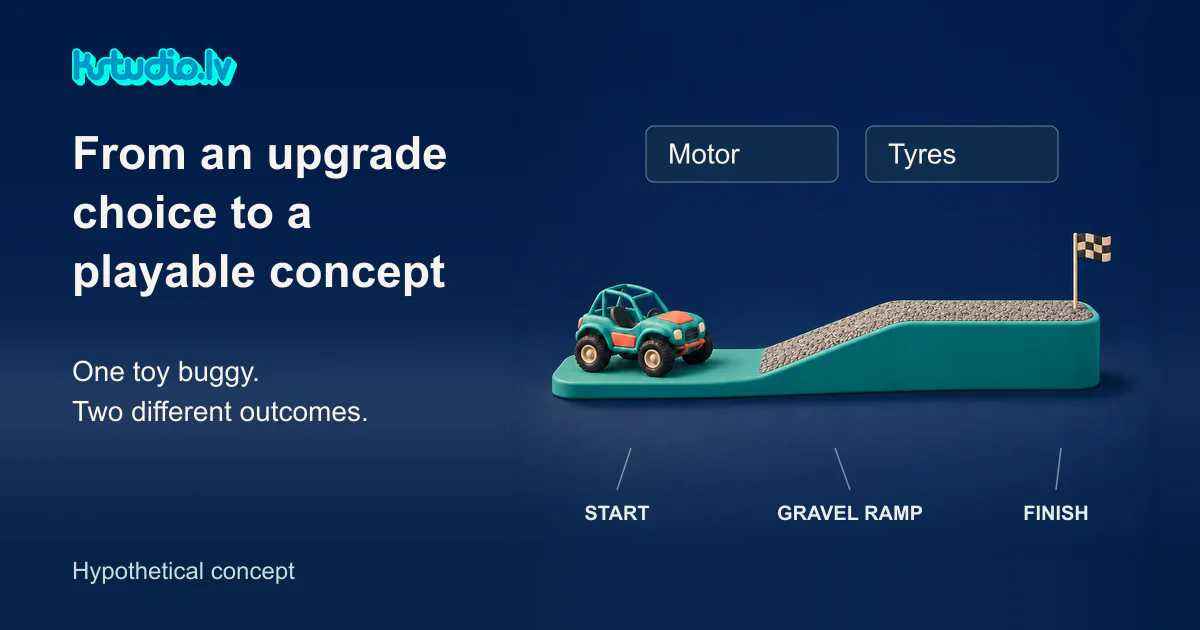
Consider an original, hypothetical concept. A toy buggy waits beside two upgrades: a stronger motor or grippy tyres. A short straight leads to a gravel ramp, with the finish at the top. The whole route is visible before the player chooses.
The motor gives the buggy a fast start. At the ramp, its ordinary tyres spin on the gravel and it stops below the crest. The grippy tyres make the buggy slower on the straight, but it keeps traction and reaches the finish.
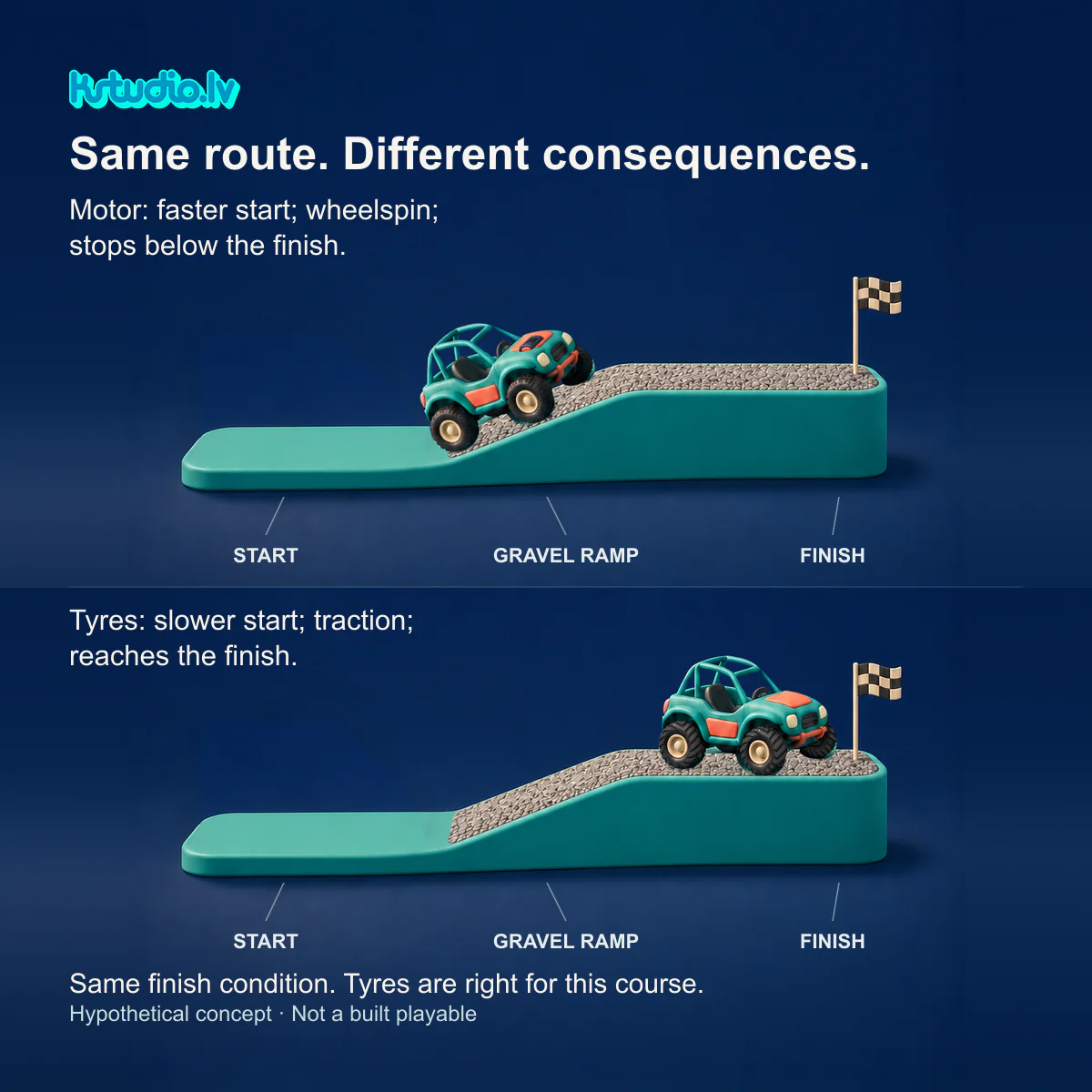
This course has a right answer: grip. Choosing power costs the player the finish. A replay could let the player try the other upgrade on the same route, with the same finish condition.
These are proposed rules for an illustrative concept. No playable has been built or tested, and this example is not a client game or a performance result.
The brief hidden inside that choice
The example gives a creative lead a concrete way to describe the interaction:
Before the choice: the player sees the straight, gravel ramp and finish, plus what each upgrade changes.
Input: choose one upgrade; no steering or second purchase is required in this proposal.
Motor outcome: quick launch, wheelspin on gravel, stop below the finish.
Tyre outcome: slower launch, maintained traction, reach the finish.
Result and replay: show the actual outcome, then allow another choice on the same course.
This makes the production question specific. The team can discuss how to show wheelspin, whether the tyre change is visible at the intended size, and which assets already exist. A menu screenshot, vehicle artwork, terrain pieces and a short recording of the real upgrade behaviour would each answer a different part of that brief.
Keep the promise connected to the game
A vehicle game does not automatically justify this mechanic. If its upgrades only raise speed, the imagined traction penalty would introduce a rule the player cannot find after installing. In that case, the concept needs a different consequence drawn from the actual game.
The same applies to the finish condition. A real title may reward distance, survival or delivery rather than reaching a flag. The ad's decision should represent the experience the product actually offers. Simplifying the scene still leaves that obligation intact.
KSTUDIO's paid production scope could cover the choice screen, the two outcome sequences and the replay interaction after the mechanic is agreed. Any additional steering, vehicle options or course changes would be separate scope decisions. This written example demonstrates the proposed reasoning; it does not establish build feasibility or campaign effectiveness.
For a later build, Playable Checker covers static HTML, ZIP and source checks. It does not execute gameplay, validate the mechanic or predict conversion.
To discuss a playable for your game, describe one upgrade choice, its distinct consequences and your available assets. A description or link to existing materials can establish the starting point.
Comments (0)
Awaiting moderation. Only you can see this.