
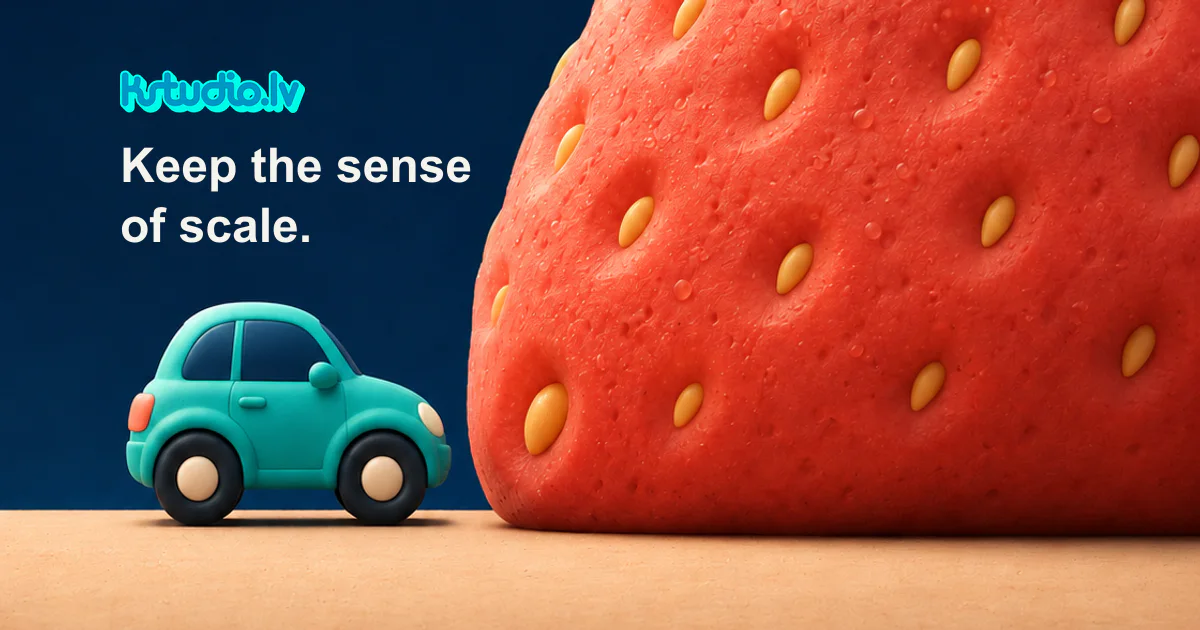
A creative lead can like a reference and still struggle to explain what the team should take from it. The objects might belong to another game. The colours might clash with the brand. Yet one quality, such as the sense of scale, could fit the new campaign.
Grounded, from Obsidian, puts an ant sized player in a backyard. The relative scale makes an ordinary environment feel monumental.
That is the quality to explore in a new brief. The question becomes: what should feel enormous beside something the viewer recognises?
A vehicle beside a strawberry
Consider a hypothetical driving game with a small, playful vehicle. Imagine parking it beside an oversized strawberry. Place one wheel near a seed so the artist has a specific size relationship to explore. Let the fruit rise beyond the top of the frame, while the vehicle remains visible below.
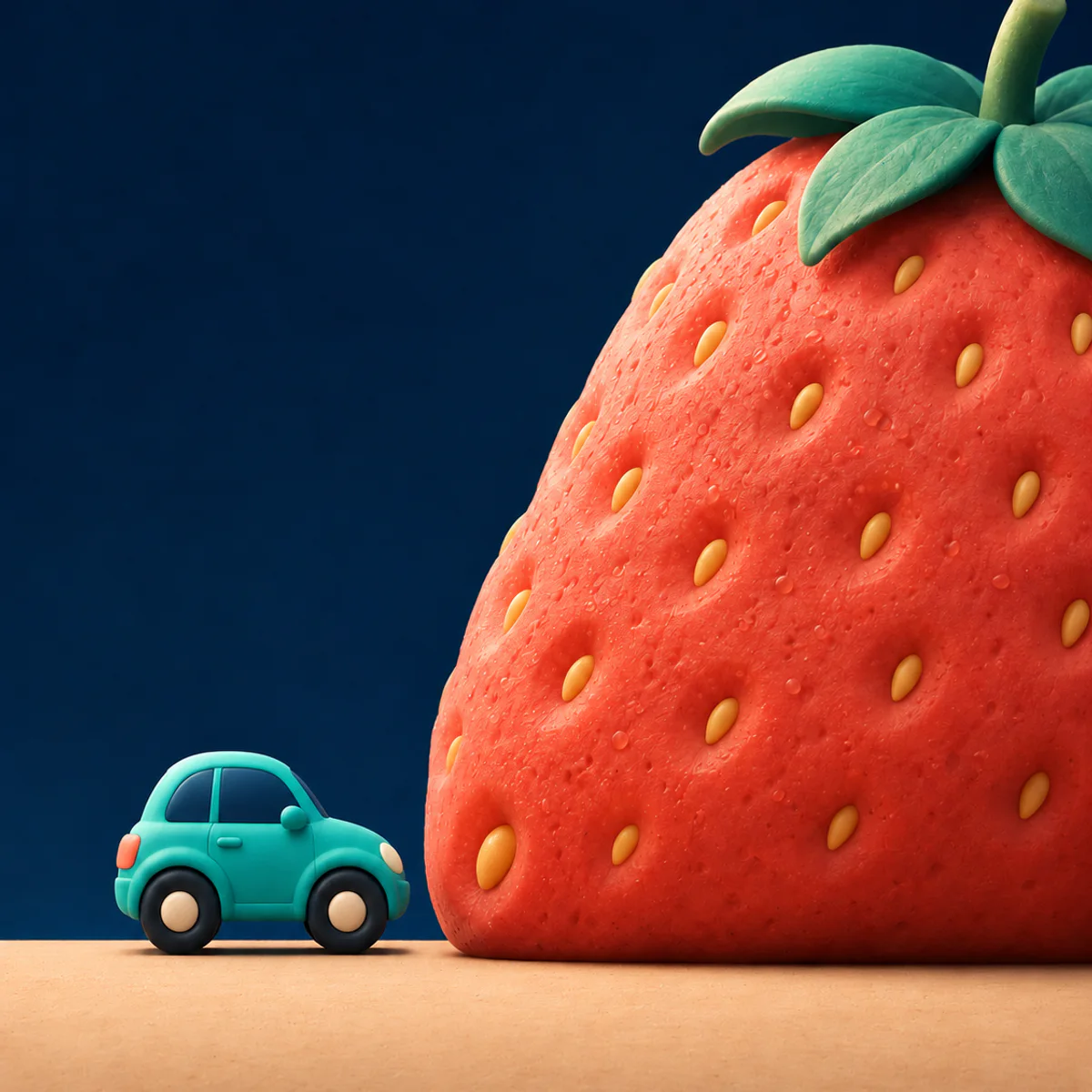
This is a proposed scene, not a finished image or a client case. Its purpose is to make the brief concrete. Grounded supplies the reference for relative scale. Our proposed vehicle, setting, materials and composition still need their own design decisions.
A low camera position would be one option to explore. Pulling back would be another if the vehicle becomes difficult to recognise. The useful question during review would be whether the small vehicle and large fruit remain legible together. The vehicle must stay recognisable for its size beside the seed to carry the idea.
A brief with a decision inside it
For this example, the brief could read:
Make an everyday object feel monumental in our playful driving world. Use our vehicle design and approved materials. Keep the whole vehicle visible, with its wheel beside a strawberry seed as the scale cue.
The first sentence names the desired quality. The second anchors the scene in materials the team owns. The final sentence gives the composition a constraint that can be checked when a draft exists.
That constraint matters when reviewing alternatives. A concept could make the strawberry imposing but leave the vehicle as an unrecognisable speck. Another could show the vehicle clearly but crop away the comparison with the seed. Each misses a different part of this particular brief. The team has a reason to revise either one without falling back on "make it more like the reference."
When giant fruit is the wrong answer
If the brand requires realistic proportions, an oversized strawberry violates the premise. A vehicle beneath a tall tree could offer a scale relationship while keeping familiar dimensions. The desired impression stays in the brief; the proposed scene changes to respect the world.
The reference also cannot decide which game assets are available, what may be altered, or which details need approval. Those are inputs to the art direction scope. Developing a concept, choosing the camera and resolving materials and lighting are production work that would need to be scoped. This written example does not establish how a final image would look.
To discuss art direction for your own concept with KSTUDIO, describe the reference quality and the game or brand materials you have. A reference link and a short description of the constraint give the discussion a concrete starting point.
Once an image exists, Static Ad Check covers file properties and crop preview.
Comments (0)
Awaiting moderation. Only you can see this.