
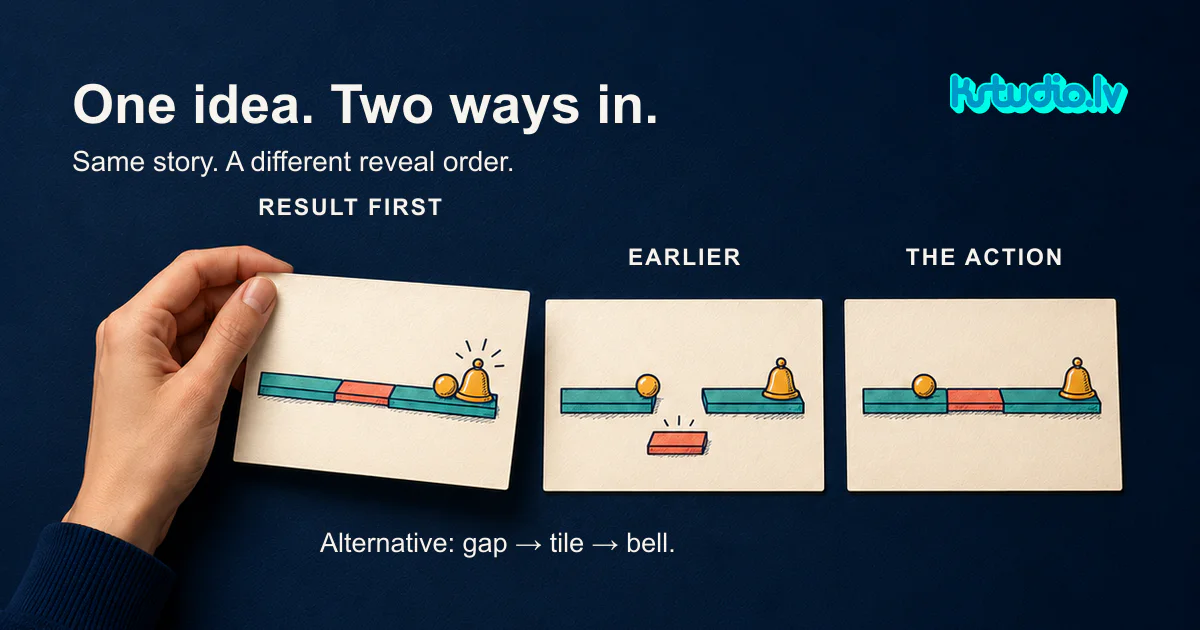
One concept. Two ways into the story.
Your team has agreed on a creative idea. The next discussion is about the opening: should viewers see the obstacle first, or the outcome? That choice belongs in the storyboard brief. It changes how the idea unfolds, and gives the client a specific decision to make before full production.
One concept sets the promise
An HLC, or high level concept, defines the core idea and angle. A storyboard turns it into frames: what happens, what viewers can see, and when information is revealed.
Our illustrative example uses one HLC: a small choice sets off a satisfying chain reaction. A red tile fills a gap in a path. A gold ball crosses it and reaches a bell. The intended pleasure comes from connecting one simple action to its consequence.
The tile, ball, path and bell stay the same in both versions. The change is the order in which viewers encounter them. KSTUDIO has developed its own illustrative storyboard studies around this comparison; these are concept studies, not finished ads, and they have not been tested with an audience.
Problem first: how will it get across?
The first frame shows the ball waiting at a gap. The missing section is large enough to read, and the space for one tile is clear. A hand places the red tile. The next frame follows the ball across the completed path; the final frame shows it reaching the bell and making it ring.
The intended opening question is “How will the ball get across?” Each shot answers part of it. The obstacle establishes the task, the tile supplies the action, and the bell completes the consequence.
This is a useful direction when the communication task is to explain the problem and the action that resolves it. Its tradeoff is that the payoff arrives later: the opening must make the unfinished situation understandable and worth following.
Result first: how did that happen?
Here, the opening shows the ball arriving at the bell as it rings. The next frame is explicitly marked “Earlier” and returns to the same ball at the same gap. The hand places the red tile, then a short passage across the path connects that action to the result already seen. A wider view ties the tile, route and bell together.
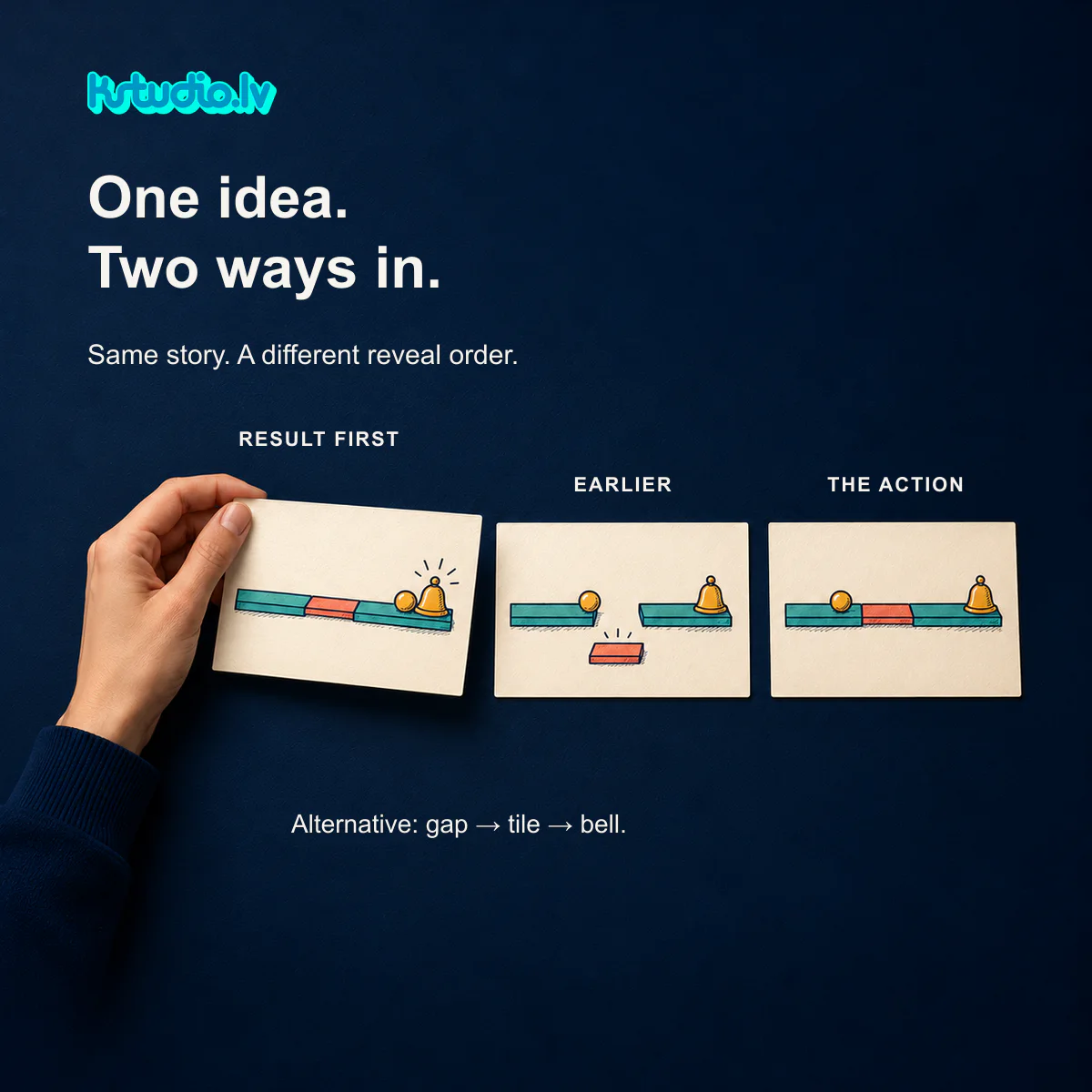
The intended question becomes “How did that happen?” This direction puts the outcome at the front of the explanation. It can suit a brief in which the result should introduce the story, with the mechanism revealed afterwards.
That structure asks more of the transition. Without a readable return to the earlier moment, viewers could interpret the gap as a new problem after the bell. The flashback must remain clear at the intended pace. These are creative intentions; neither sequence carries a retention or CTR prediction.
Choose for the communication task
A useful client brief names the shared HLC, the intended opening question and the information each frame must provide. For this example, the decision is whether explaining the obstacle or introducing the outcome should come first.
During a practical read through, someone unfamiliar with the brief describes what happened after seeing the frames in order. Their explanation can expose a missing connection or an unclear flashback. This is a review of the storyboard's readability, separate from a campaign performance test.
KSTUDIO can help develop the concept and storyboard around that communication task, then carry the chosen sequence into production. After export, its Video Ad Check provides file metadata and a placement reference preview; story selection remains a creative decision.
Choose the opening that fits the question you want viewers to ask.
Comments (0)
Awaiting moderation. Only you can see this.