
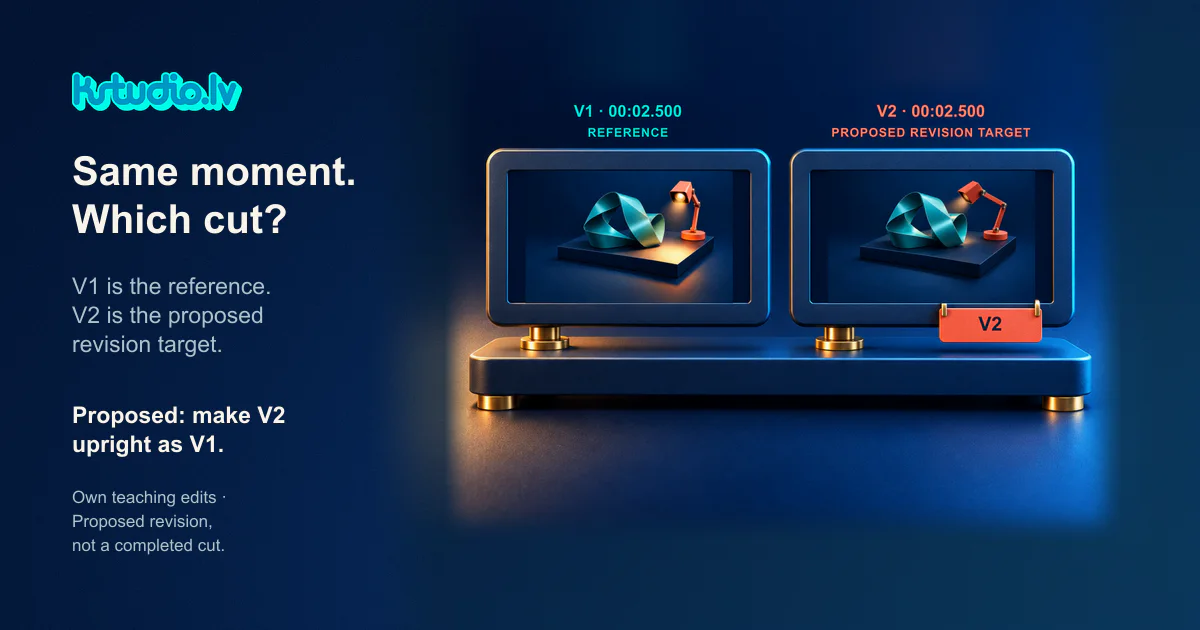
A bounded revision is easier to discuss when the brief identifies both the work to change and the material that should return for review. The buyer supplies the intended change; the production partner can then scope how to make it.
Our teaching example uses two existing edits of an AI lamp animation. At exactly 00:02.500, V1 shows the lamp upright. At the same timecode, V2 shows it bending left towards the ribbon. The timestamp locates a moment, but the version determines which work the note addresses.
Name the proposed revision
The example brief is specific:
V2 / 00:02.500 / Make the lamp upright here, matching V1. Preserve the framing.
V2 is the cut to change. V1 is the pose reference. The instruction names the result and one element to preserve, without prescribing every editing step.
In an actual review, these version labels should resolve to fixed reviewed files or stable review links. Reusing a filename for different cuts would leave the address ambiguous again.
Define the expected return
For this proposed revision, the handoff would include a newly identified revised cut, a frame from the reviewed moment and a short change note. V1 would remain attached as the reference.
The cut lets the buyer inspect the revision in motion. The frame supports comparison at the specified moment. The change note tells the reviewer what was altered and what the brief asked to preserve.
This is a concrete production request to scope. The partner can identify dependencies or constraints before work begins, and the buyer knows which material should arrive for the next review. It also keeps a reference frame from being mistaken for the revised deliverable itself.
What exists in this example
V1 and V2 are actual controlled edits of our own animation. The revision brief and return package described here are proposals; no revised cut has been made from the note. There is no client exchange or measured time saving behind the example.
The useful result is a small handoff agreement: the exact work to change, the intended result and the material that will make the next review possible.
Put the version, timecode and intended change in your next review note.
Comments (0)
Awaiting moderation. Only you can see this.