
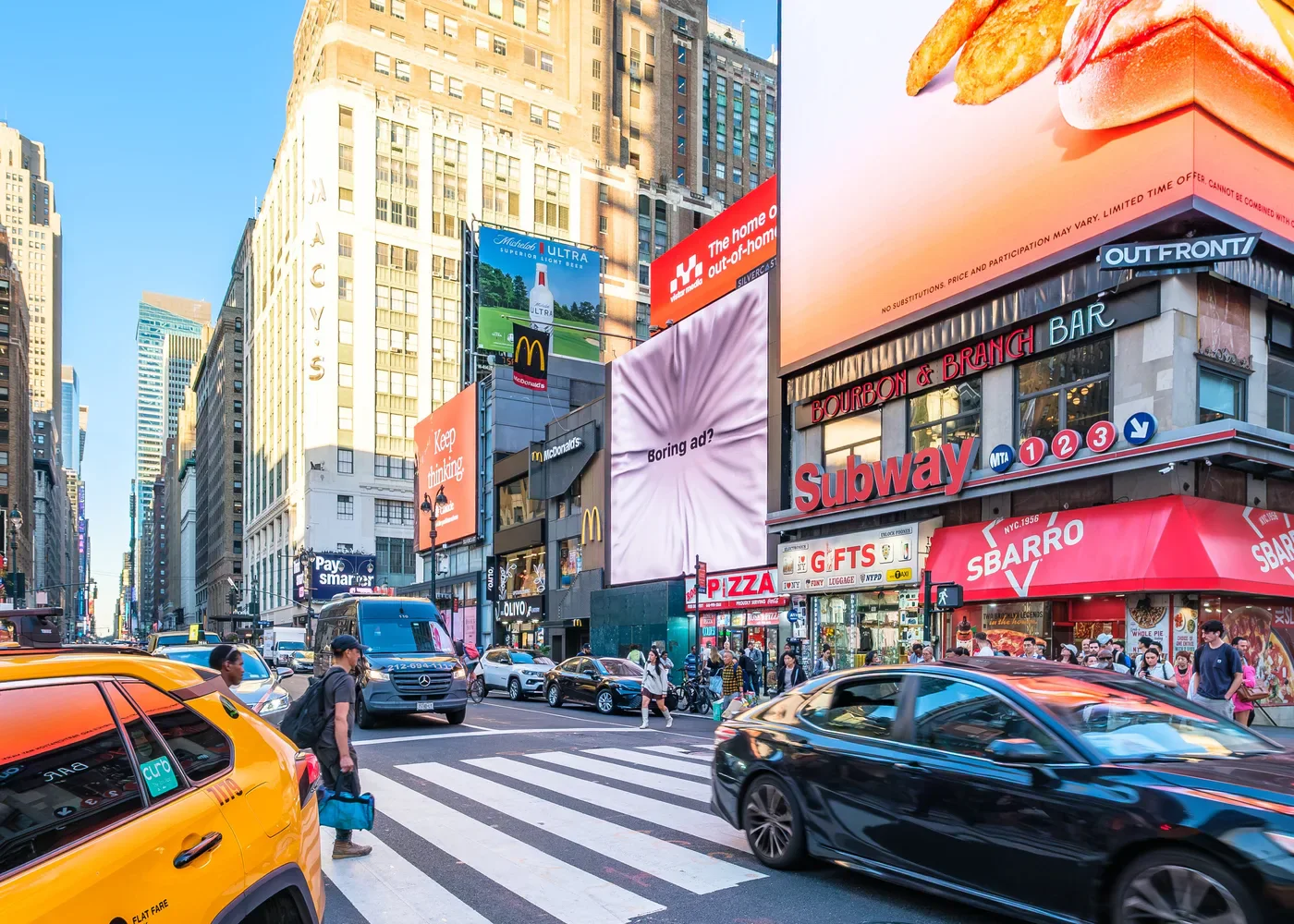
KStudio contributed 3D asset creation to Vistar Media’s 2025 “Out-of-Home, Fully Realized” campaign. Developed by Vistar’s in-house team, the campaign combined digital and static outdoor advertising across six markets. Source: Vistar Media’s campaign overview.
Our contribution opens a broader production conversation: how should a three-dimensional visual work across very different places? A large outdoor display, a narrow panel and a still image each give a creative team different opportunities. Below, we share KSTUDIO’s recommendations for approaching that challenge when planning your next outdoor brief.
Start with the viewing moment
Begin with a description of where someone will encounter the creative. Consider their distance from the screen, their likely direction of travel and the time they may have to look. Those questions help decide which part of a composition deserves the most emphasis.
Give the viewer one clear focal point. A distinctive shape, product silhouette or deliberate contrast can establish that priority. Try reducing the composition to a small preview: if the main subject becomes difficult to identify, simplify the surrounding detail before adding more animation.
Give the asset room to travel
Think about adaptation while defining the visual. A composition with space around its main subject gives a designer more options when placing a headline, adjusting a crop or accommodating a different screen shape.
For a new project, we recommend listing the intended formats in the brief and reviewing rough compositions for each one early. Keep the subject’s scale, the relationship between objects and the position of the brand mark deliberate in every version. A family of layouts can share a visual identity while allowing each placement its own composition.
Make motion and stills work together
A useful planning exercise is to choose a strong still composition before developing the motion around it. Ask which frame communicates the idea on its own, and which movement would add something meaningful to it. This creates a concrete starting point for discussing both animated and static deliverables.
For a loop, review different entry points. Imagine arriving halfway through the sequence: is the subject recognisable, and is there enough context to understand what is being advertised? Keep the brand and message legible throughout the moments intended to carry them.
Review in the placement
Review a creative inside a representation of its intended environment. Look at it at a reduced size, with surrounding visual clutter, and within the actual aspect ratio. This can expose awkward crops, competing focal points or a logo that feels detached from the composition.
Before final delivery, obtain the specifications from the media owner or platform for each booked placement. Use that information to check dimensions, duration, playback behaviour and export settings as applicable. Keep the visual review and the technical review as two explicit steps, with an owner for each.
Bring the brief into focus
Start the production conversation with the campaign idea, the intended placements and the deliverables you need. Add references that explain the desired visual character and identify anything that must remain consistent across versions. A clear brief gives everyone a shared basis for evaluating the first compositions.
Planning an outdoor campaign with 3D creative? Explore KSTUDIO’s DOOH work or talk to us about your brief.
Comments (0)
Awaiting moderation. Only you can see this.