
When a video and playable are commissioned together, the production brief can name the action that connects them. The handoff should then make that connection inspectable in both files.
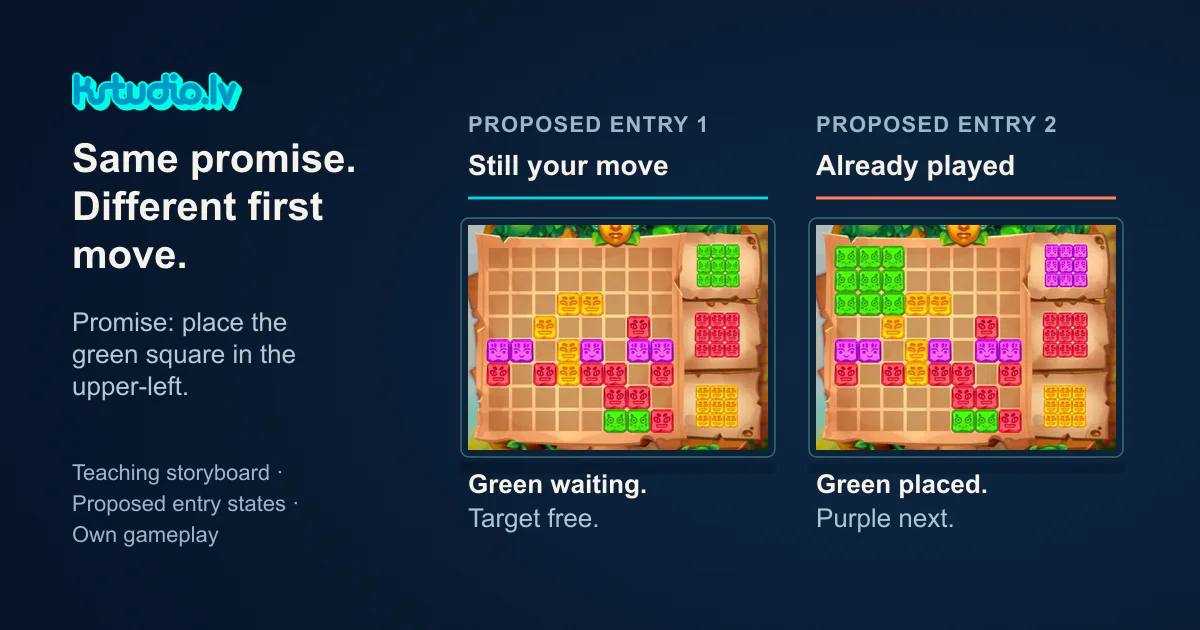
Our Adventure Blocks teaching storyboard provides a concrete example. Its proposed promise is to place the green square in the upper left of the board. The matching playable entry needs to leave that move available.
Specify the state to build
The source recording gives us two useful states. Before the move, the green square is in the tray and the upper left target is free. After the move, green is settled on the board and a purple square is offered next.
For the stated promise, the first state supplies the production requirement: the same green piece, the same free target and the same expected placement result. A build beginning with the later state would offer a different next action.
That does not make the later state a bad creative choice. It means the video’s invitation would need to change with it.
Define what comes back for review
The proposed handoff is a video cut and an identified playable build, accompanied by a side by side view of the promised move and the build’s opening state. The receiving team can inspect whether the brief’s piece, target and action are present.
This gives the production partner a bounded job. The task includes preparing the two materials around one specified action and making their relationship easy to review. A different colour treatment or a polished export would not, on its own, answer that acceptance question.
Keep the example in scope
These proposed entry choices use real states from one archived recording. No new paired build or live ad to playable transition was created for this study. It does not establish loading behaviour, an installed game journey or campaign performance.
The value for the next brief is the concrete state to make and the review material to return. Both can be agreed before the production work begins.
Review the video and playable entry side by side before approving them.
Comments (0)
Awaiting moderation. Only you can see this.