
Your campaign already has a creative team, a direction and people responsible for decisions. Where would another studio fit?
Start at the point where its work enters your team's next step. If an editor needs a finished 3D shot, that is a different contribution from a scene another artist will continue developing. Naming the handover gives both sides something concrete to discuss.
Vistar credits its internal Marketing team and Creative Studio with the campaign, and KSTUDIO with 3D asset creation on its official campaign page.
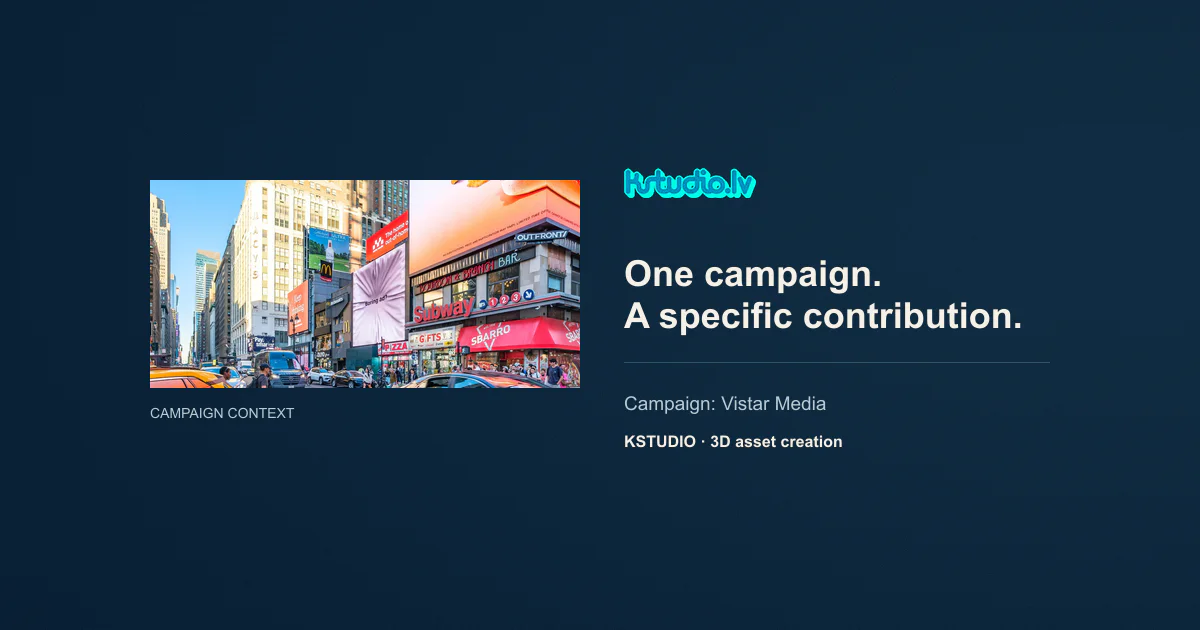
The cover photograph shows that campaign in place. It is campaign context, not a picture of KSTUDIO's 3D assets in isolation.
That credit establishes a contribution alongside an internal team. The framework below is our recommendation for your project, rather than a reconstruction of Vistar's production process.
Write the contribution from its next use
Try this sentence:
“We need [one 3D output], using [available inputs], ready for [its next use]. Approval sits with [a named person].”
Each blank exposes a decision worth making. Is the output a model someone else will animate, or a finished shot an editor will place into a sequence? Is the design approved, or does developing the appearance belong in the assignment?
Imagine commissioning one product animation for an existing campaign. The approved product design, references and intended action give the discussion a starting point. The editor can then explain what needs to arrive for the next stage of work.
Bring that person into the scope discussion. Ask what they need to receive and what they will do with it. A file labelled “final” is less informative than an agreed output with a known destination.
Put the approval decision beside the output
Separate material you can provide from decisions you have made.
An approved design is a decision. A reference image communicates that design. An editable scene may be a usable production input. List them individually so the prospective partner can assess the starting point.
Then name who can accept the contribution. For an internal creative lead, this is a chance to decide which choices stay with the team and which choices the specialist is being asked to develop.
We suggest an early review around a concrete question: does the appearance fit the approved direction, or does the motion communicate the intended action? Choose the question that needs answering before more work proceeds. If the answer requires a decision from your team, put that decision into the plan alongside production.
Keep uncertain inputs and open choices visible. They are part of the scope conversation.
Check the export for its actual destination
Once there is a finished file, review it against the requirements of its next use.
For your campaign's social exports, KSTUDIO's free video ad check and static ad check provide file checks and framing previews. They don't validate DOOH delivery requirements; obtain those from the relevant media owner or delivery partner.
The earlier production conversation establishes what to make and who accepts it. The export check has a narrower job: examining the file that now exists.
You have a defined contribution to discuss when you can name what goes in, what comes back and who takes it forward.
Have a campaign in motion and need a specific 3D contribution? Tell us what's already in place and what still needs to be made. A description is enough to start; private project files can stay with your team until a suitable sharing route is agreed.
Production transparency note: this article was drafted with AI assistance and reviewed by KSTUDIO. The cover uses a campaign photograph from our published Vistar Media case article.
Comments (0)
Awaiting moderation. Only you can see this.