
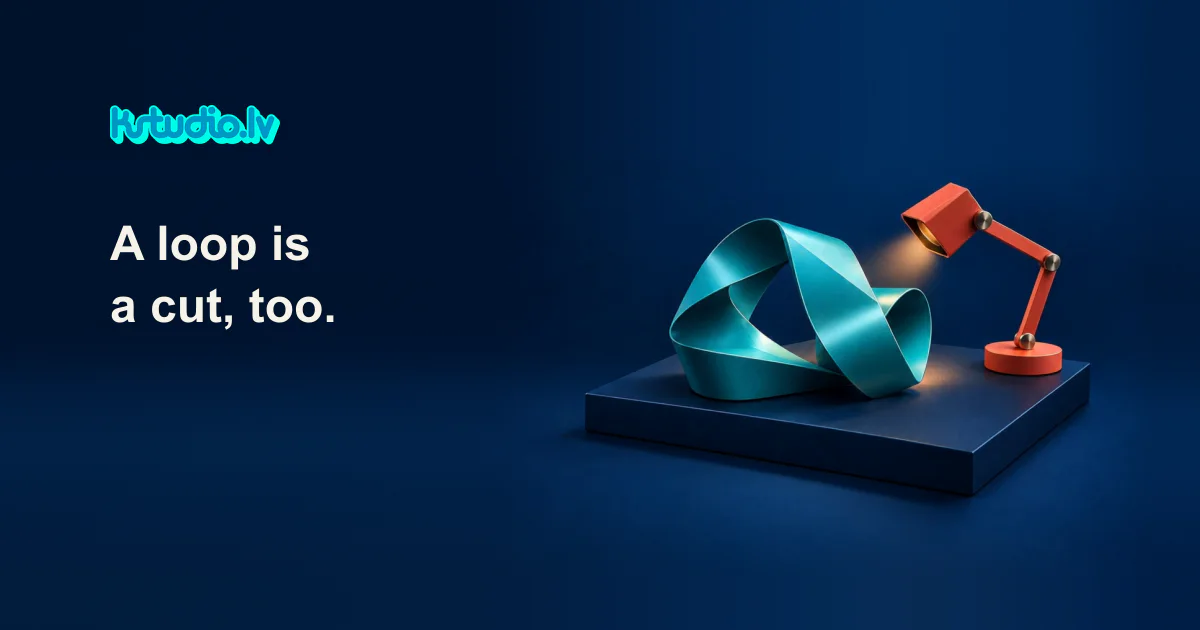
A loop has one more cut to review: the last frame back to the first.
The images below compare frames immediately before and after the repeat boundary. They show pose and light, not how the motion feels.
Two joins, four stills
The illustration uses our own AI generated lamp animation. We made two controlled teaching edits from the same source segment, then selected the last and first frames at each repeat boundary. These are new examples, not a claim that an older published clip was faulty.
In the top row, Cut to start, the edit holds the end pose and then returns directly to the starting frame. The lamp changes position across that cut, and the light changes with it. The pair joins source frame 45 to source frame 15.
In the bottom row, Reverse + pause, the edit plays the same segment backward to its start and pauses there before repeating. The two sides of this boundary use the same source frame: 15 to 15. The pose and lighting therefore match at this join.
The comparison isolates that reset. It does not prove that the second edit has natural or continuously flowing motion.
What the stills can, and cannot, tell us
A last/first comparison makes a position or lighting mismatch easy to locate. It cannot show the speed approaching the cut, the length of a pause or the feel of a direction change.
The return in the second edit is reverse playback plus deliberate pauses. No new return animation was generated. The light and the other scene motion run backward too, so this construction may suit one action and contradict another.
Matching frames are a useful check, not a seamless loop certificate. The motion around them still needs to be reviewed at its intended speed.
Turn the comparison into a precise editing note
For your own clip, compare the final frame with the first. Identify what changes across that boundary: the subject’s pose, its position or the light. Then watch the movement around the join. If there is a pause or reversal, decide whether it belongs to the intended action.
This gives a production review two distinct observations: what changes at the cut, and how the transition feels in motion. Keeping them separate is more useful than asking for a vague improvement to the loop.
Three repeats are a practical viewing exercise, not a validated quality threshold. The goal is a specific editing note, not a claim about engagement or campaign performance.
Watch three repeats of your clip and inspect the last to first transition, not just the ending.
Comments (0)
Awaiting moderation. Only you can see this.