
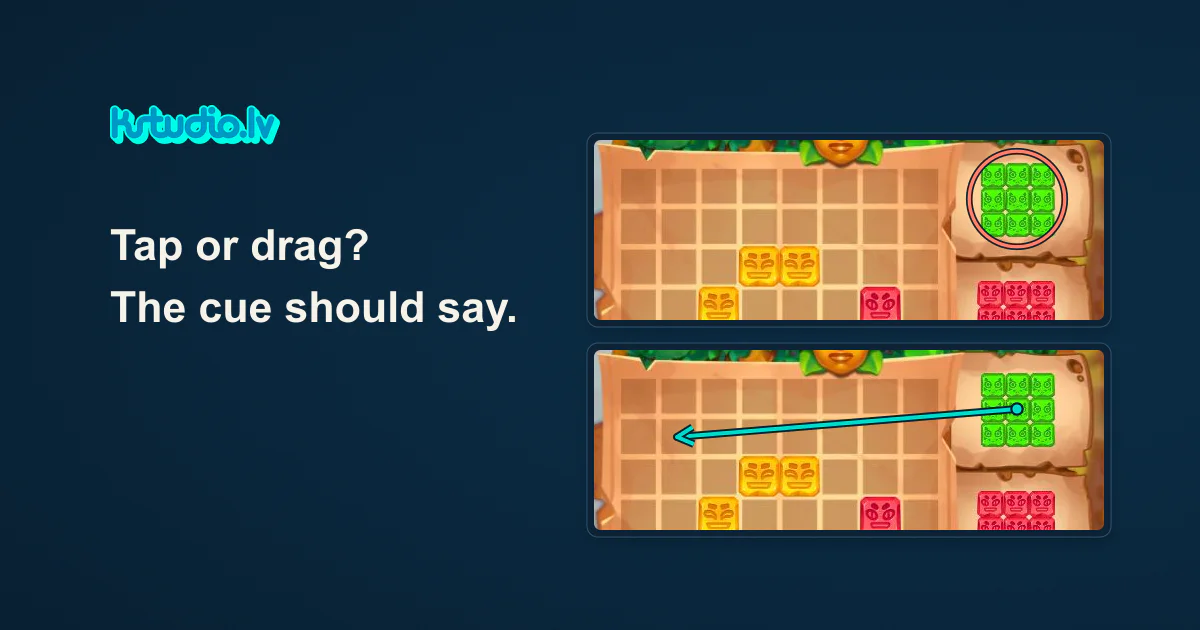
Tap or drag? A highlighted piece does not, by itself, answer that question.
When reviewing an input cue, it helps to separate what the player should touch from the movement being illustrated. A point marks a location. A path can show a start, a direction and a destination. That is the distinction in this small KSTUDIO teaching study.
One game state, two added instructions
The source is an actual frame from our Adventure Blocks demo, captured on 3 October. We keep the board, pieces and tray unchanged. The comparison adds a point cue to identify the piece, then an illustrative path to show the demonstrated drag.
These overlays were made for this article. They are not screenshots of two shipped interfaces, and the drawn path is not an exact recorded cursor trace.
Real sampled game states in the archive record the action itself: the green piece moves from the tray into the free area at the top left of the board. Nothing here establishes what a tap alone would do; that was not tested.
What the comparison makes visible
The point and the path contain different information. Both can identify the piece. The path additionally illustrates movement toward a destination. That does not prove the second cue is easier for players to understand. It makes a specific production question available for review.
Changing brightness or adding another pulse may draw attention to the piece, but it does not necessarily add the missing direction. The useful discussion is about the instruction being given, before it becomes a discussion about decoration.
A bounded review method
Start with the actual input demonstrated in the build. Name the object, the gesture and the destination. Then compare those three details with what the cue depicts. If the cue only identifies the object, decide whether the rest of the instruction is supplied elsewhere or needs to be shown.
Keep the game state fixed while comparing cue ideas. Otherwise a different board arrangement can change the question at the same time as the visual instruction.
This is a design review, not a usability finding. We have not measured player comprehension, completion or campaign performance. The study shows how to make one interface decision concrete enough to discuss with a production partner.
Compare the cue in your playable with the gesture it asks the player to make.
Comments (0)
Awaiting moderation. Only you can see this.